
A QUESTLARK CHAPTER
Spiritfarer: Farewell Edition
A relationship game whose most meaningful choices concern where to place attention, effort and care aboard a changing home.
Game facts
- Developer
- Thunder Lotus
- Publisher
- Thunder Lotus
- Released
- 18 August 2020
- Platforms
- Windows · macOS · Linux (Steam edition)
- Model
- Paid game
- PEGI
- 12 · Mild Swearing, Sexual Innuendo — Steam UK listing
- Players
- Single-player · Multi-player · Co-op · Shared/Split Screen Co-op
- Length
- Long
- Difficulty
- 2 / 5 · Approachable
- Steam Deck
- Verified
PEGI source ↗ · Steam Deck status source ↗
Edition: Base game
The score, explained
The interest and responsiveness of the core decisions and actions.
How progression, exploration and goals fit together.
The coherence of the visual, musical and narrative presentation.
How clearly the game explains its rules and offers useful ways to engage.
The depth of optional goals, alternative approaches and reasons to return.
Preferences make care specific
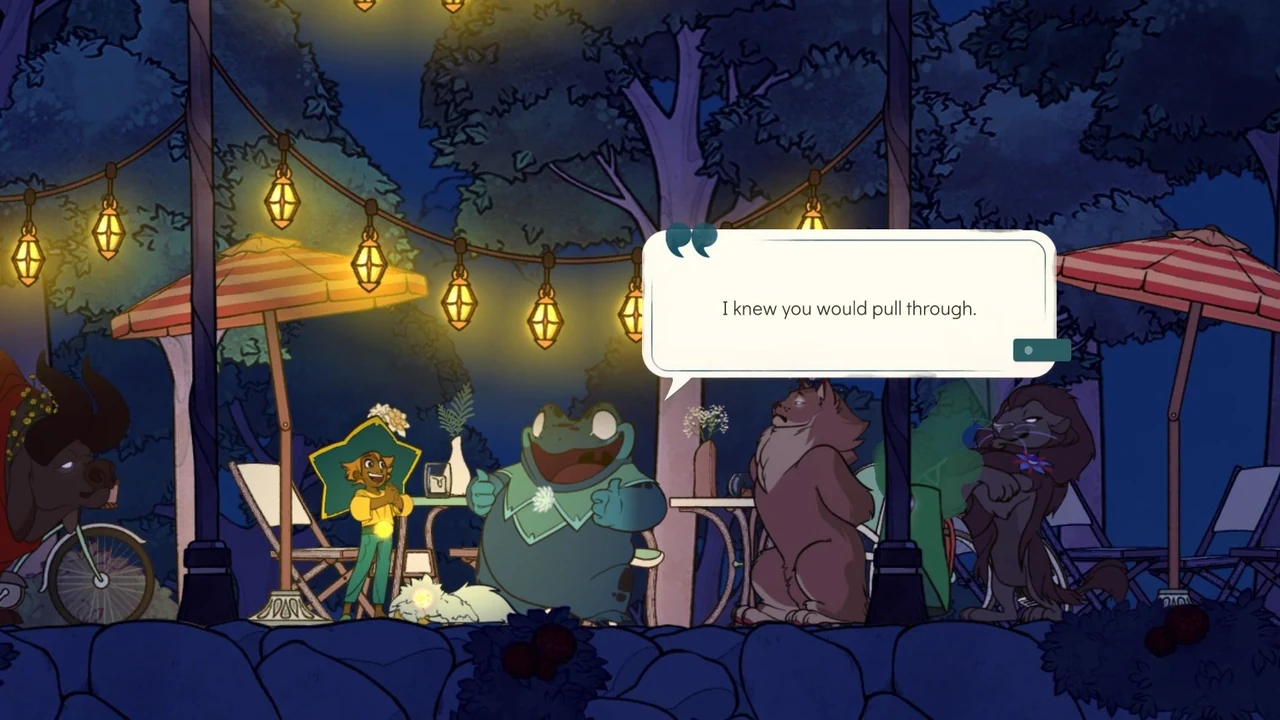
Spiritfarer turns looking after passengers into a sequence of particular decisions. A meal, a room or a completed request matters because different spirits have different tastes and needs. Stella's boat becomes a place where remembering those differences is part of the player's role. That is the game's strongest fit for Quest Lark: care is expressed through attention to a person rather than through choosing a generic supportive response in a conversation. The early routines establish who enjoys what, who is difficult to please and which concerns remain unresolved. As the boat grows, deciding whose request to pursue next becomes a practical way of organising emotional attention. The relationship develops through repeated actions that make the passenger's presence part of everyday life aboard the vessel.
Helping does not make every relationship simple
The spirits are not uniformly agreeable, and their requests can reveal discomfort, stubbornness or conflict as well as affection. That complexity gives the act of helping more substance. A player can care about someone without finding every interaction easy, and a familiar routine can carry mixed feelings. Travel and resource gathering create the practical conditions for those relationships, while the eventual departures change the boat's social arrangement. The game is effective when the player notices how a task has become associated with a particular person. Preparing a favourite dish or visiting a destination is then more than progression towards a marker. It is part of a relationship that has acquired its own habits, making the prospect of its ending feel concrete before the final conversation arrives.
The work around the feelings is substantial
Spiritfarer asks for repeated crafting, cooking, growing and travelling. Those activities can establish a comforting rhythm, but they can also delay the next development in a relationship the player is eager to follow. The narrative themes include loss and death, so the inviting artwork should not be treated as evidence that the experience is emotionally light. Players seeking a large range of dialogue outcomes will also find that the main stories are more directed than their practical freedom aboard the boat might suggest. The choices concern attention, order and participation more than a constant ability to rewrite a passenger's fate. Its recommendation depends on whether that form of involvement feels sufficient. The daily work needs to become part of caring, rather than simply the price of reaching another scene.
For a player willing to make room for someone
Choose Spiritfarer when you want relationships to occupy space in a world you actively maintain. The boat makes attachment visible through rooms, routines and preferences, while the continuing journey gives those relationships a finite shape. It is particularly suitable for players who can find meaning in small repeated acts and accept that helping does not always lead to a comfortable resolution. A concise, dialogue-led adventure will suit someone who wants less management around the story. The distinctive contribution here is the way practical attention becomes emotional memory. A passenger can be remembered through the place they occupied and the things you learned to do for them, giving an ordinary action a significance that remains after the person who prompted it has departed.
The verdict
A relationship game whose most meaningful choices concern where to place attention, effort and care aboard a changing home.
Reasons to play
- Individual preferences reward remembering people
- Care can coexist with difficult relationships
- Rooms and routines make absence tangible
Reasons to think twice
- Management can delay desired conversations
- Practical freedom exceeds control over the main stories
See the game

Assist & accessibility
Explore the available settings and control options on the official game page before choosing your setup.
Parents’ guide
Players: Single-player · Multi-player · Co-op · Shared/Split Screen Co-op. No in-game purchase marker in the checked Steam listing. Separate downloadable content may be sold.
Age classification: 12. Mild Swearing · Sexual Innuendo Steam UK listing
A useful starting tip
Group several passengers' needs before a journey so that gathering has a clear purpose beyond filling storage.
A different direction
Compare this with Wildermyth: A rewarding home for consequential character events, where a surprising decision can become the defining memory of a hero.
Official sources
Reviewed: November 2026
You might also like
 Katana ZERORead review →
 PentimentRead review →
 WildermythRead review →