A QUESTLARK CHAPTER
Pentiment
An exceptional choice-led investigation that takes incomplete judgement seriously and leaves its consequences with a living community.
Game facts
- Developer
- Obsidian Entertainment
- Publisher
- Xbox Game Studios
- Released
- 14 November 2022
- Platforms
- Windows (Steam edition)
- Model
- Paid game
- PEGI
- 16 · Bad Language — Steam UK listing
- Players
- Single-player
- Length
- Medium
- Difficulty
- 2 / 5 · Approachable
- Steam Deck
- Verified
PEGI source ↗ · Steam Deck status source ↗
Edition: Base game
The score, explained
The interest and responsiveness of the core decisions and actions.
How progression, exploration and goals fit together.
The coherence of the visual, musical and narrative presentation.
How clearly the game explains its rules and offers useful ways to engage.
The depth of optional goals, alternative approaches and reasons to return.
Choose whom to believe before certainty arrives
Pentiment's most important resource is attention. Andreas can investigate, speak with people and learn about Tassing, but he cannot give every lead unlimited time before a decision is required. That limitation makes a conversation more than a convenient way to collect all available information. Choosing one person may leave another perspective less understood, and a persuasive account can still be shaped by fear, resentment or social position. This is why the game is central to Quest Lark's selection. It asks the player to make a judgement under conditions that resemble an actual community dispute: several people have reasons for what they say, the evidence is incomplete, and the consequences of choosing an account will be carried by people who remain in the town afterwards.
Background changes the way a question can be asked
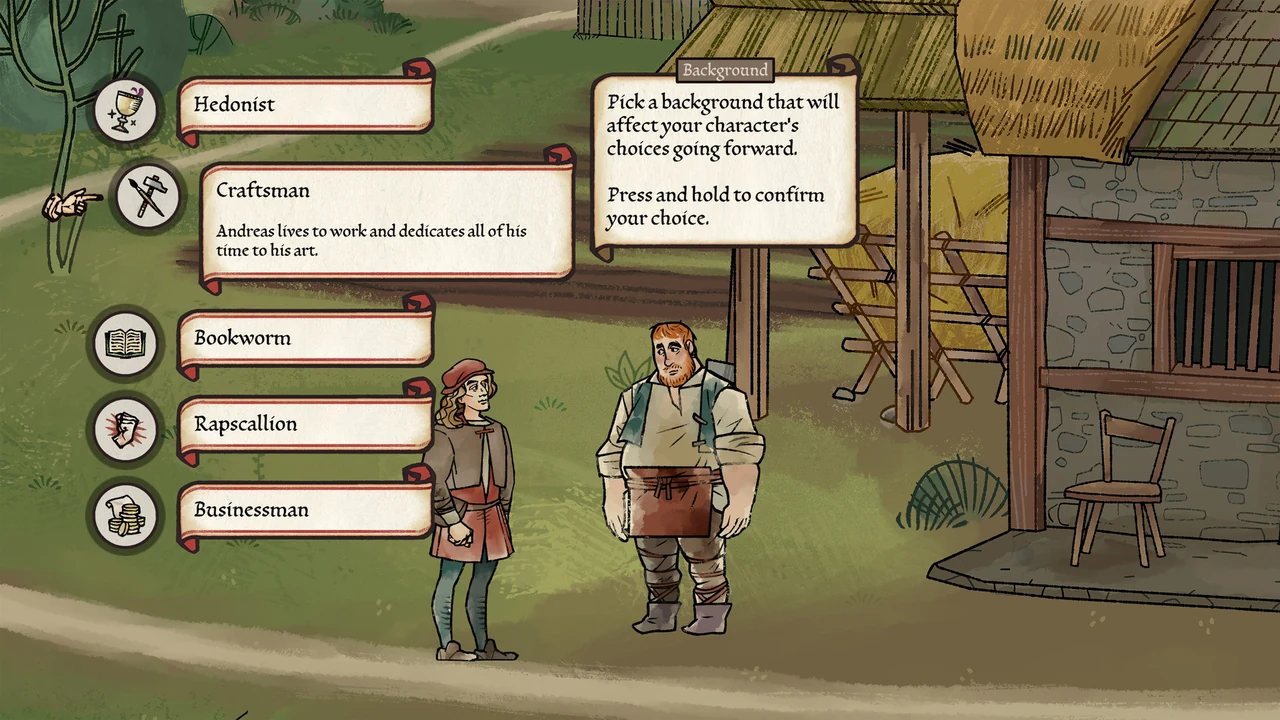
The selected details of Andreas's education and experience give conversations different possibilities. That makes character creation useful without requiring combat statistics or a large equipment system. An area of knowledge can open an observation, but it does not grant complete understanding of another person's life. Meals and informal visits are particularly valuable because they place information inside social relationships. A person behaves differently among family, neighbours or religious authority, and those contexts affect how a statement should be read. The game's later periods then show that decisions do not disappear when an investigation ends. What was accepted, remembered or left unresolved can become part of the town's shared account, giving a choice a life beyond its immediate effect on the current scene.
The discomfort is deliberate
Pentiment can leave a careful player uncertain about whether enough was known to act fairly. That feeling is not an accidental failure to provide a convenient final clue; it is closely connected to the game's interest in responsibility and historical memory. Players who need a mystery to reveal one indisputable solution may find that approach unsatisfying. The experience also asks for sustained reading and attention to historical context, with little action to interrupt the conversation-led rhythm. The manuscript presentation is expressive, but it does not turn the subject into a light puzzle. A strong recommendation therefore depends on willingness to live with an imperfect judgement. The player must care about gathering evidence while accepting that diligence and certainty are not always the same achievement.
The consequences belong to a community
Choose Pentiment when you want decisions to matter through people and memory rather than through a visible morality meter. The scale is local enough for relationships to become familiar, yet the passage of time gives events a reach beyond the first impression of the town. It is especially rewarding for readers interested in how class, belief and work influence what can be said and who is believed. The authored protagonist gives those choices a grounded social position. Players seeking a broad fantasy adventure or frequent combat should look elsewhere. The distinctive value is the seriousness with which the game treats a limited act of judgement: Andreas cannot know everything, but the people around him still need an answer, and they must continue living with the answer he helps create.
The verdict
An exceptional choice-led investigation that takes incomplete judgement seriously and leaves its consequences with a living community.
Reasons to play
- Limited attention makes each lead matter
- Background shapes useful conversational options
- Community memory carries choices across time
Reasons to think twice
- Diligence does not guarantee certainty
- Historical context rewards sustained reading
See the game
Assist & accessibility
Explore the available settings and control options on the official game page before choosing your setup.
Parents’ guide
Players: Single-player. No in-game purchase marker in the checked Steam listing. Separate downloadable content may be sold.
Age classification: 16. Bad Language Steam UK listing
A useful starting tip
Choose the lead that best fits your current reasoning instead of assuming every possible conversation must be exhausted first.
A different direction
Compare this with Chants of Sennaar: A thoughtful interpretation game that makes reconsidering an assumption about another community feel like meaningful progress.
Official sources
Reviewed: November 2026
You might also like
 Katana ZERORead review →
 WildermythRead review →
 Chants of SennaarRead review →