
A QUESTLARK CHAPTER
Chants of Sennaar
A thoughtful interpretation game that makes reconsidering an assumption about another community feel like meaningful progress.
Game facts
- Developer
- Rundisc
- Publisher
- Focus Entertainment
- Released
- 5 September 2023
- Platforms
- Windows (Steam edition)
- Model
- Paid game
- PEGI
- 7 — Nintendo Switch download edition edition; not a separate PC classification
- Players
- Single-player
- Length
- Short
- Difficulty
- 3 / 5 · Moderate
- Steam Deck
- Verified
PEGI source ↗ · Steam Deck status source ↗
Edition: Base game
The score, explained
The interest and responsiveness of the core decisions and actions.
How progression, exploration and goals fit together.
The coherence of the visual, musical and narrative presentation.
How clearly the game explains its rules and offers useful ways to engage.
The depth of optional goals, alternative approaches and reasons to return.
A guess is a decision about another person
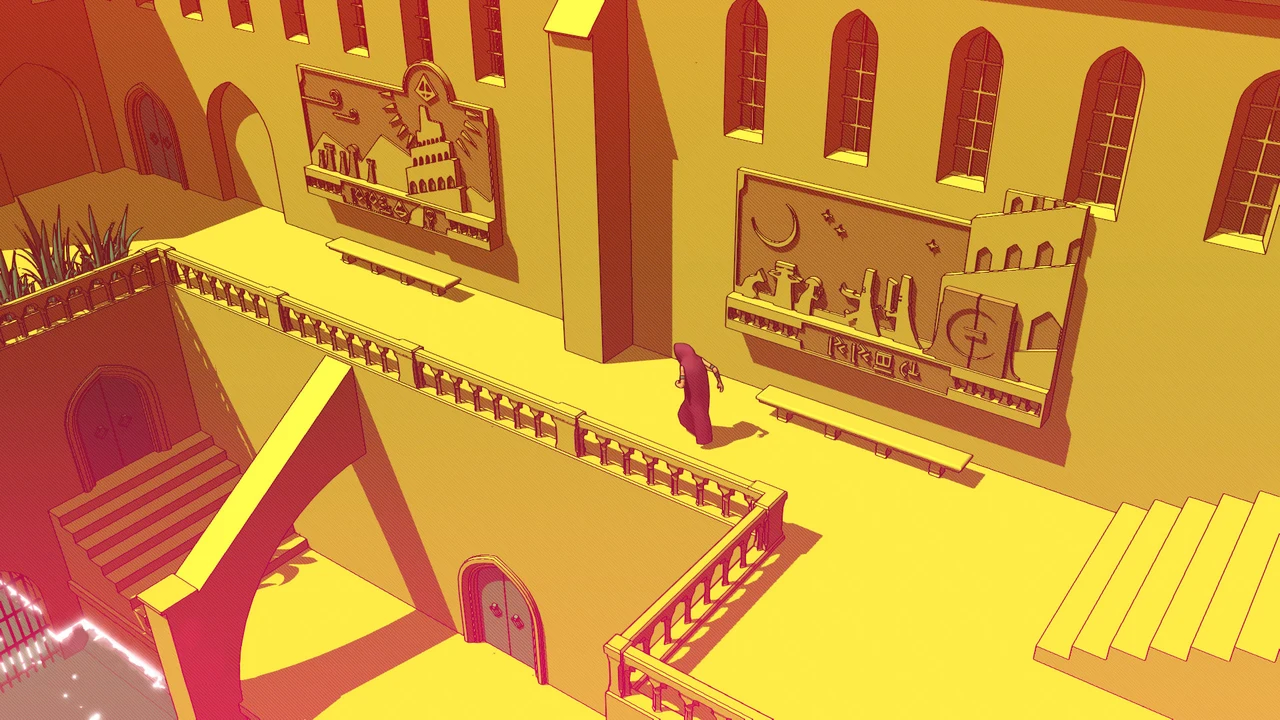
Chants of Sennaar asks the player to infer meaning before a language becomes readable. That makes the first response to a community unusually revealing: do you assume a gesture is welcoming, restrictive, practical or ceremonial? The notebook allows those assumptions to be recorded and reconsidered as more context appears. Quest Lark's interest is in this process of interpretation. The player's choices do not primarily branch the plot; they determine how understanding is built. An incorrect guess can persist until another scene exposes the mistake, encouraging a more careful reading of people and places. The game gives curiosity a disciplined form, asking for evidence from repeated actions and relationships rather than treating the first plausible explanation as a sufficient account of what somebody means.
Words belong to a social setting
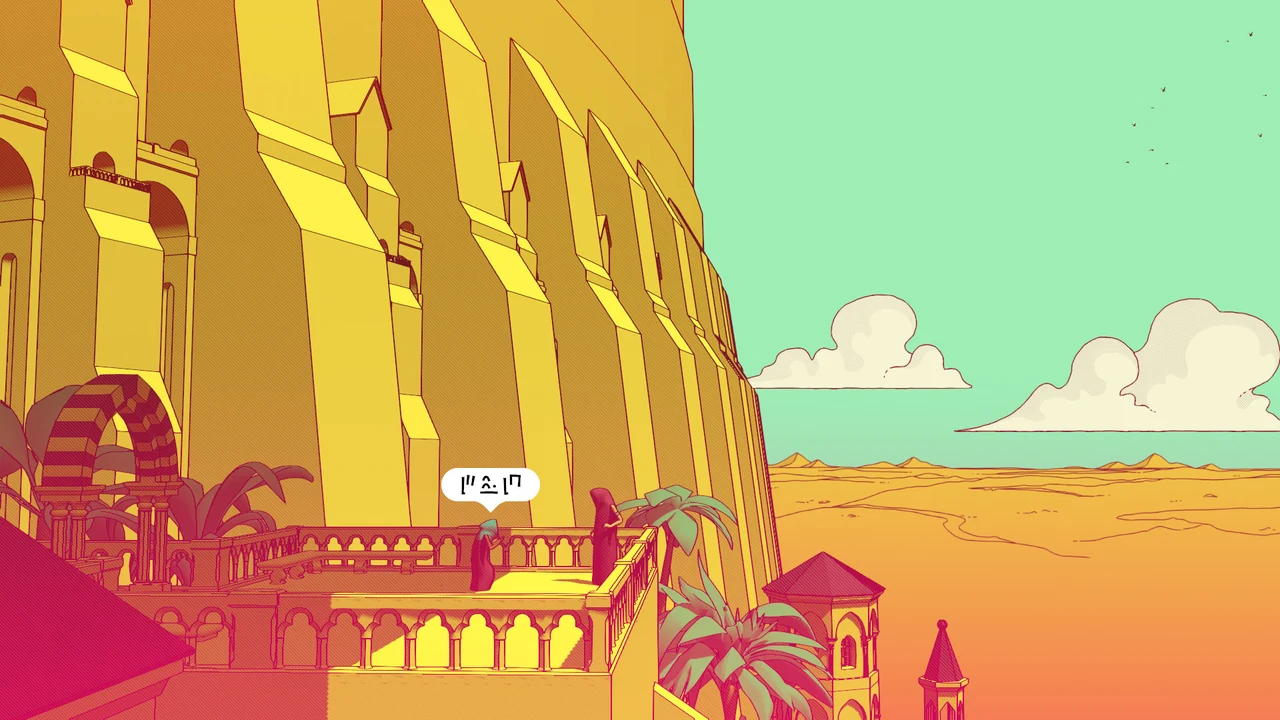
Different parts of the tower use different languages, and their architecture, routines and priorities help explain why particular words matter. Learning is therefore more than matching a symbol to an isolated English equivalent. A command has meaning because of who gives it and what happens when others respond. A label becomes clearer through the object or activity surrounding it. As the player moves between communities, earlier assumptions can be revised in light of another group's perspective. That gives the puzzle system an ethical texture without requiring a morality menu. The practical task is to understand accurately, and the broader satisfaction comes from seeing a division become less absolute once communication is possible. Successful interpretation changes the player's relationship to the people being observed.
Observation can become a bottleneck
The game sometimes depends on a small contextual clue that is easy to miss. When that happens, uncertainty can stop feeling productive and begin to feel like searching for the one interaction the notebook expects. The occasional stealth sequence also asks for a different kind of attention from the careful linguistic observation that defines the strongest parts. Players seeking frequent dialogue options or personalised relationships should understand the nature of the experience. Chants of Sennaar offers agency through inference and exploration, with an authored journey guiding the larger direction. It is most enjoyable when revisiting a place with a better question feels worthwhile. If repeating an observation after a mistaken interpretation feels like wasted effort, the game's central learning process may be less appealing than its striking presentation initially suggests.
A thoughtful choice for patient curiosity
Choose Chants of Sennaar when you want a story game that asks you to understand before it asks you to judge. Its languages make the process concrete, while the tower's communities provide different social contexts for the same basic act of listening carefully. The experience is focused enough for individual discoveries to feel significant, and the notebook keeps learning active rather than reducing it to passive exposition. It suits readers who enjoy visual puzzles and can remain comfortable with an incomplete interpretation. A conventional branching dialogue adventure will offer more direct control over events. This game's particular contribution is different: it makes changing your mind about what another person means feel like progress, and shows how much of a world can become accessible through that change alone.
The verdict
A thoughtful interpretation game that makes reconsidering an assumption about another community feel like meaningful progress.
Reasons to play
- Notebook guesses can be tested against context
- Language is rooted in social routines
- Communication changes the meaning of divisions
Reasons to think twice
- A missed observation can become a bottleneck
- Agency centres on inference rather than branching dialogue
See the game
Assist & accessibility
Parents’ guide
Players: Single-player. No in-game purchase marker in the checked Steam listing. Separate downloadable content may be sold.
Age classification: 7. Nintendo Switch download edition edition; not a separate PC classification
A useful starting tip
Keep a word meaning provisional until it explains more than one context; a plausible first guess can make later scenes misleading.
A different direction
Compare this with Katana ZERO: A tense, concentrated story that makes the timing of a response part of how a character expresses resistance or restraint.
Official sources
Reviewed: November 2026
You might also like
 Katana ZERORead review →
 PentimentRead review →
 WildermythRead review →